As trust and wealth leaders prepare for the 2026 budgeting cycle, they face a landscape defined by steady but moderate growth, rising operational demands, and a demographic shift reshaping client expectations. Global assets under management (AUM) reached $147 trillion by mid-2025, according to McKinsey—showing positive growth that is beginning to slow. Meanwhile, FDIC data shows U.S. banks holding $24.5 trillion in assets in early 2025, with profitability stable but under close board scrutiny for risk-aware, margin-defensible strategies.
One key pressure point is intergenerational wealth transfer. Cerulli Associates estimates that approximately 70% of heirs change advisors, making advisor capacity, modernization, and client experience top priorities for the year ahead.

Market Forces Reshaping Bank Trust Priorities
Model portfolios continue to grow quickly. Morningstar reports $646 billion in third-party model assets, while Yahoo Finance estimates nearly $8 trillion in total model-based assets. More than 80% of fee-based advisors now use models for part of their practice.
At the same time, expectations for customization are rising. Custom models were ranked as a top priority by 65% of model providers. This drives substantial operational lift if those models are built in-house. Add to that the accelerating migration into semi-liquid alternatives, $349 billion in 2024, with projections into the trillions by 2030, requiring trust departments to handle diligence, liquidity oversight, reporting, and data management.

Research from Datos Insights, prepared for AssetMark, shows that many trust institutions still rely on fragmented systems with limited automation, creating what they call an “operational inefficiency tax.” Of surveyed trust organizations, 43% report only basic integration among systems and another 14% report minimal integration, meaning data remains siloed and manual work proliferates.
This fragmentation forces banks to rely on shadow accounting, manual reconciliation, spreadsheet-driven compliance, and dual data entry, adding operational risk and consuming staff time.
Evaluating Build vs. Buy Through the Lens of Efficiency and Capacity
When evaluating whether to build in-house or outsource, institutions typically focus on three core factors: speed to market, capacity, and controls.
Building in-house offers full ownership and governance, but extends timelines for product delivery, model updates, and platform integration. It also demands ongoing investment in talent, infrastructure, and risk management, resources many trust departments struggle to scale.
Outsourcing can accelerate time-to-market while reducing operational strain. State Street Global Advisors research shows that advisors who outsource spend about half as much time on investment management tasks (11.8% vs. 22.4%) allowing them to focus more on client engagement. In the Datos survey of trust and wealth executives, 100% of respondents said client experience impact is a critically or very important factor in outsourcing decisions, followed by regulatory compliance (79%) and operational risk (71%). Additionally, 28% of executives see outsourcing as having significant or transformative impact, particularly for smaller accounts or transitioning portfolios.
Most importantly, outsourcing paired with integration can eliminate the hidden costs Datos highlights: the 5–10 basis points of operational overhead many banks unknowingly carry due to fragmented workflows.
How Leading Institutions Are Modernizing Their Approach
Trust organizations adopting integrated outsourcing models are already seeing measurable improvements.
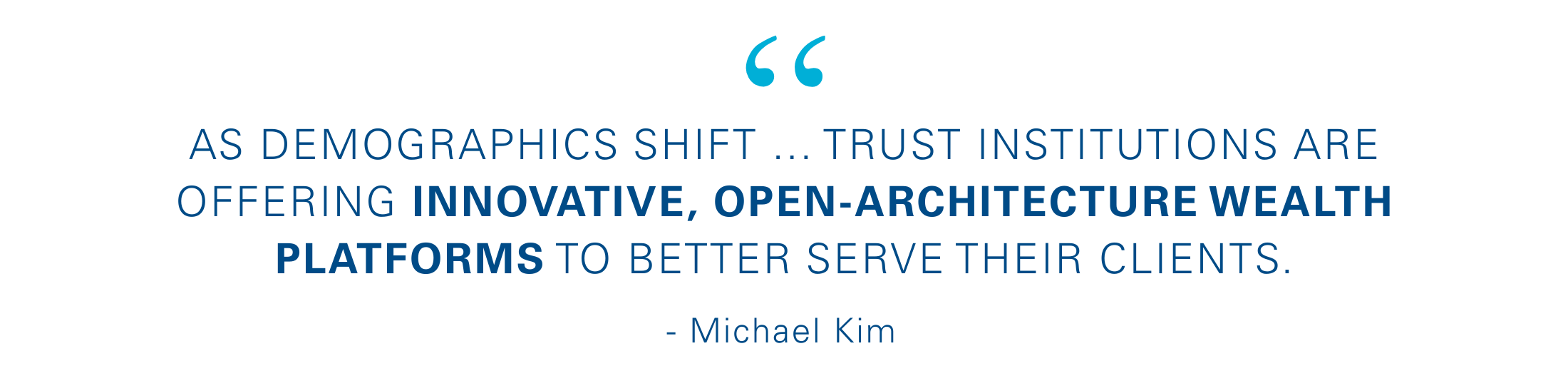
Frontier Bank uses the AssetMark–Cheetah platform to modernize trust operations, reduce administrative overhead, and deliver curated investment options with improved digital access. As Michael Kim, CEO and President of AssetMark, notes, “As demographics shift and clients expect a holistic wealth advisory experience, trust institutions are offering innovative, open-architecture wealth platforms to better serve their clients.”
First State Bank (TX) reports similar operational gains. Curtis Groves, SVP of Wealth Management and Trust, calls the solution a “cost-effective force multiplier” that allows teams to concentrate on client relationships and growth.
Datos Insights underscores why these shifts matter. Its study shows that 79% of surveyed banks expect significant or transformative efficiency improvements from unified access and single sign-on often saving five to ten minutes per day per employee, equivalent to more than 30 hours per month for a 25-person team.
A Scalable Path Forward for 2026 and Beyond
As trust departments plan for 2026, many face a pivotal decision: continue relying on legacy systems and internal builds, or adopt integrated outsourcing that strengthens client experience, improves advisor capacity, and modernizes the wealth offering without additional strain.
Datos Insights warns that trust organizations failing to evolve risk falling behind. Top-quartile organizations outperform peers in wealth revenue by almost tenfold, driven not by market position but by operational excellence and integrated systems.
AssetMark’s Bank Trust Solutions is built for this moment, it provides a unified platform supporting outsourced model delivery, tax-aware rebalancing, API-driven integration, advanced automation, and consolidated reporting.
For institutions evaluating their next step, now is an ideal time to explore how an integrated platform can support efficient growth, deepen client engagement, and position the organization competitively for the decade ahead.
©2025 AssetMark, Inc. All rights reserved.
8659766.1. | 12/2025 | EXP 12/31/2027