Succession has often been misunderstood or categorized as a single event: sell your entire book when you are ready to retire.
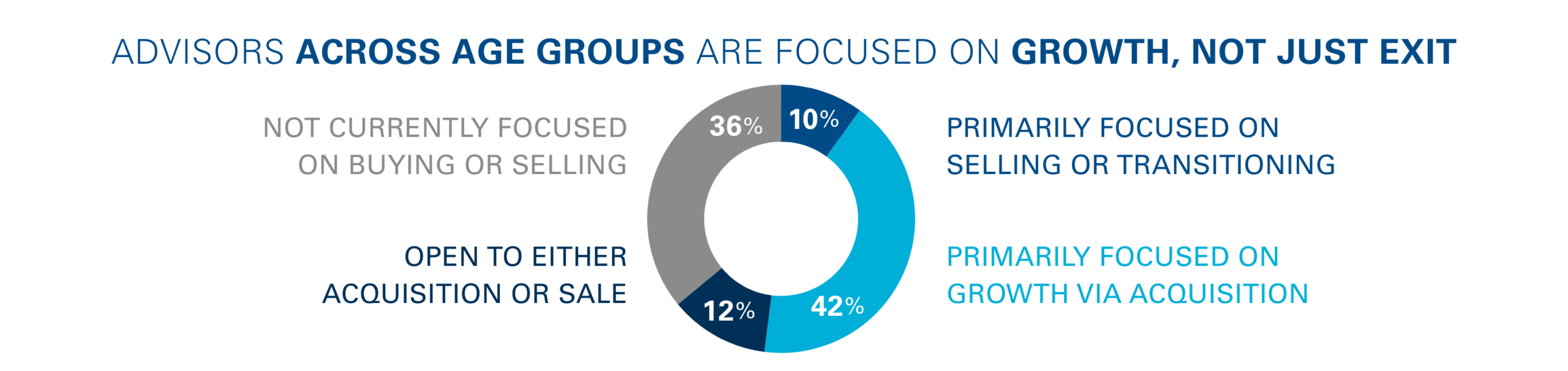
AssetMark’s 2025 Advisor Succession Survey shows a different picture. Among 174 advisors across 33 firms, about 10% are primarily looking to sell or transition, 42% are focused on growth through acquisition, and 12% are open to either acquisition or sale. The rest are not actively buying or selling but are thinking about how their practice will evolve over time. Of those looking to sell, 67% want to sell their full book and 33% want to sell part of their book. These partial book sellers are the expanded view of traditional succession, demonstrating that succession decisions and opportunities span the advisor lifecycle, not just the years leading up to retirement.
Why? Advisors are trying to balance growth, lifestyle, specialization, and legacy. Some want to buy practices to accelerate expansion. Others want to improve their own quality of life by selling their business or parts of their book. Many are refining a niche—by geography, client type or service model—while others are focused on legacy, building a firm that can endure or transition to a family member, heir or trusted associate. Each of these paths is complex, which makes succession a difficult topic to navigate. Advisors have more support options than ever, but our survey reveals that much of that support shows up as generic education and valuation resources instead of personalized help that makes execution feel possible.
This mix of heightened interest, more options and an unresolved planning gap is pushing succession from a one-time decision to an ongoing, lifecycle strategy. A modern succession plan should be formalized, yet flexible.
Why so many advisors still lack a formal plan
Succession is under planned, but not because advisors do not care. Often the help they receive does not match what is required to act.
Among advisors who say they are looking to sell, 57% do not have a formal succession plan. Many work in long-established practices, including firms that have operated more than 20 years. Among advisors 65 and older, 26% are focused on selling or transitioning and 20% on growth by acquisition, yet nearly half, about 47%, do not have a formal plan. Succession support from wealth management firms is available but limited. About half of potential sellers and 41% of buyers receive firm help, mostly in the form of education and valuation resources. What advisors say they want most are one-on-one guidance, flexible options and simplified experiences.
Many buyers also report that finding the right practice is a top challenge. About 80% of advisors who want to acquire have not yet found the practice they want. This lack of a documented plan is driven less by inertia and more by a mismatch between broad, education-heavy support and the individualized, lifecycle guidance advisors feel they need to commit to and execute a succession strategy.
Full-book sellers, partial-book buyers and growth at every age
The survey also shows a gap between how sellers and buyers view deals and confirms that many advisors, including more tenured ones, still want to grow, not just exit.

Among advisors planning to sell, 67% prefer a full-book sale and 33% a partial sale, while 85% of prospective buyers are open to acquiring only part of a practice and just 15% want full-book deals. Some advisors, 12% of those surveyed, want to participate in both sides of the transaction, showing interest in both acquisition and sales. These “Explorers” want to optimize their practice for client niches, geographies, and service model parameters, while maintaining growth – and growth is not limited to younger advisors.
Growth via acquisition was prioritized by 42% of all respondents, including many in mid and late career, and even among advisors 65-plus only about a quarter say selling or transitioning is their primary goal and nearly half still lack a plan.
A lifecycle succession plan should recognize that advisors may sell, buy or do both at different points, and that those who plan earlier can use partial transitions to tap strong buyer demand, reshape or de-risk their book and still target a full exit later, while many late-career sellers will understandably favor a single full-book sale into retirement.

Lifecycle motivations and what advisors should do now
Motivations for selling, buying or partially transitioning show up at every stage and shift over time. Full-book sellers tend to be closer to retirement, with motivations centered on a clean exit and client continuity. Partial sellers are more likely to emphasize reshaping their book and workload — for example, pruning misaligned clients, freeing time or focusing on a core niche. Buyers across ages focus on growth, talent and expanding into new markets or segments.
A lifecycle approach to succession is still a formal plan. It is documented and revisited as advisors move from growth to optimization to eventual transition, rather than treated as a one-time problem to solve at the end of a career.
Strong succession outcomes rarely happen by accident. A formal, flexible lifecycle plan gives advisors a way to make deliberate decisions at each chapter of their career—whether that means selling, buying or doing both over time. A practical next step is to identify where you are on the continuum today: primarily growing and acquiring, optimizing through client and book reshaping or preparing for a partial or full transition. From there, start documenting your goals, timelines and preferred structures now, especially if you are in the later stage of your career, so you are not among the many advisors, including those over 65, who still do not have a plan.
©2025 AssetMark, Inc. All rights reserved.
86858891 | 01/2026 | EXP 01/06/2028