Key Takeaways
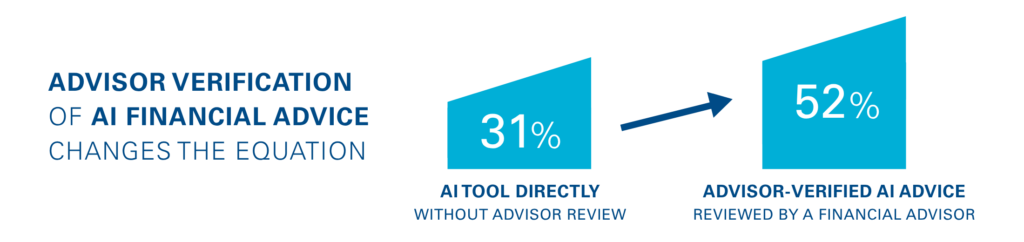
- Comfort with AI-generated financial advice nearly doubles, from 31% to 52%, once a financial advisor verifies it (CFP Board, 2024).
- 94% of advisors say AI can reduce time spent on meeting preparation, but 65% have not built it into a consistent workflow (AssetMark Gold Forum survey, February 2026).
- 85% of investment industry employers want industry-wide AI standards before broader adoption (CFA Institute, 2024).
Clients do not need more noise. They need a clearer conversation.
A market headline breaks. A portfolio moves. A tax question comes up before a major life event. In moments like these, clients rarely want a data dump. They want an advisor who can explain what changed, what did not, and what to discuss next.
AI’s most useful role in wealth management is not to replace an advisor; no one needs to panic. AI’s best use case is helping advisors show up better prepared for the conversations where clients need context, clarity, and confidence.
That conversation does not start from zero. It draws on everything the advisor already knows about this client: the retirement date, the kid starting college, and the reason the portfolio is built the way it is. Clients are not only asking for an explanation. They are asking for help from someone who has been paying attention.
“AI can help reduce that operational and interpretive burden,” says Alex Pape, Chief Product and Technology Officer, AssetMark. “Not by replacing advisors, but by giving them a more thoughtful starting point – surfacing relevant insights, organizing data, and creating clarity where there used to be friction. The most valuable use of AI isn’t replacing human interaction. It’s creating more space for it.”

For advisors already short on time, that space is not a luxury. It is what lets you serve clients the way you set out to when you entered this field: helping people work toward what actually matters to them.
The data shows why human verification matters
The trust gap among investor is real. CFP Board reported that 31% of individual investors were comfortable receiving financial advice directly from an AI tool, a share that rose to 52% once a financial advisor verified it. FINRA Foundation found the same year that 63% of respondents turned to a financial professional when making financial decisions, compared with 5% who used AI.
Clients are not rejecting AI. They are asking for a person to stand behind it, which keeps the advisor relationship at the center of the decision, not the tool or the information it provides.
AI can improve preparation, not replace judgment
Think about the work that happens before a high-value meeting: reviewing portfolio movement, client history, planning context, and the questions a client is likely to raise. AI can help organize those inputs, draft plain-language explanations for a market move or a tax change, and flag the themes worth raising next, giving advisors more time back for the conversation itself.
In AssetMark’s February 2026 Gold Forum survey, 94% of advisors said AI could help reduce time spent on tasks such as client meeting preparation. The advisor still decides what is relevant, appropriate, and consistent with each client’s goals, risk tolerance, and firm policy. AI can shorten the path to that decision. It does not make the decision.
Responsible use needs standards and training
Financial advice is a high-trust profession, and responsible AI adoption is one of the clearest trends shaping advisor practices this year. CFA Institute reported in 2024 that 85% of investment industry employers see a need for industry-wide AI standards and ethical guidelines.
AssetMark’s Gold Forum survey points to where those standards matter most. 45% of advisors cited uncertainty about how to apply AI effectively, and 37% cited compliance and data-security considerations as a barrier.
The principle holds regardless of the tool: the more personal the conversation, the more important the human review becomes. This is not just about accuracy, but is also about maintaining and building trust and connection with your clients.
AI should make advice feel more personal, not less
Advisors see the promise. Most have not built it into daily practice. In the same Gold Forum survey, 65% said they are not yet using AI in a consistent, embedded way.
Closing that gap does not require a bigger leap. It requires connecting the data back to the client experience: using AI to organize context, prepare sharper questions, and communicate with more relevance, while the advisor stays accountable for judgment and review.
The most useful AI may be the kind clients never see directly. They will feel it anyway: a clearer answer, a steadier conversation, and room for the parts of the meeting that used to get cut short — a real review of goals, a fuller conversation about a life change, event a few minutes to talk about the trip they’re planning.
Ready to turn technology into more meaningful client conversations? Explore AssetMark’s AI for Advisors resources and see how our technology, insights, and support can help your firm strengthen client relationships and create more time for the work only an advisor can do.